Blog
SAN, DAS and hybrid flash, explained for buyers
Storage vocabulary hides a simple set of choices. An array can attach to the hosts it serves or to a network those hosts share; media inside the array can be all disk, all flash, or a managed mixture. This article untangles the three terms buyers meet most — SAN, DAS and hybrid flash — and the decisions they actually represent.
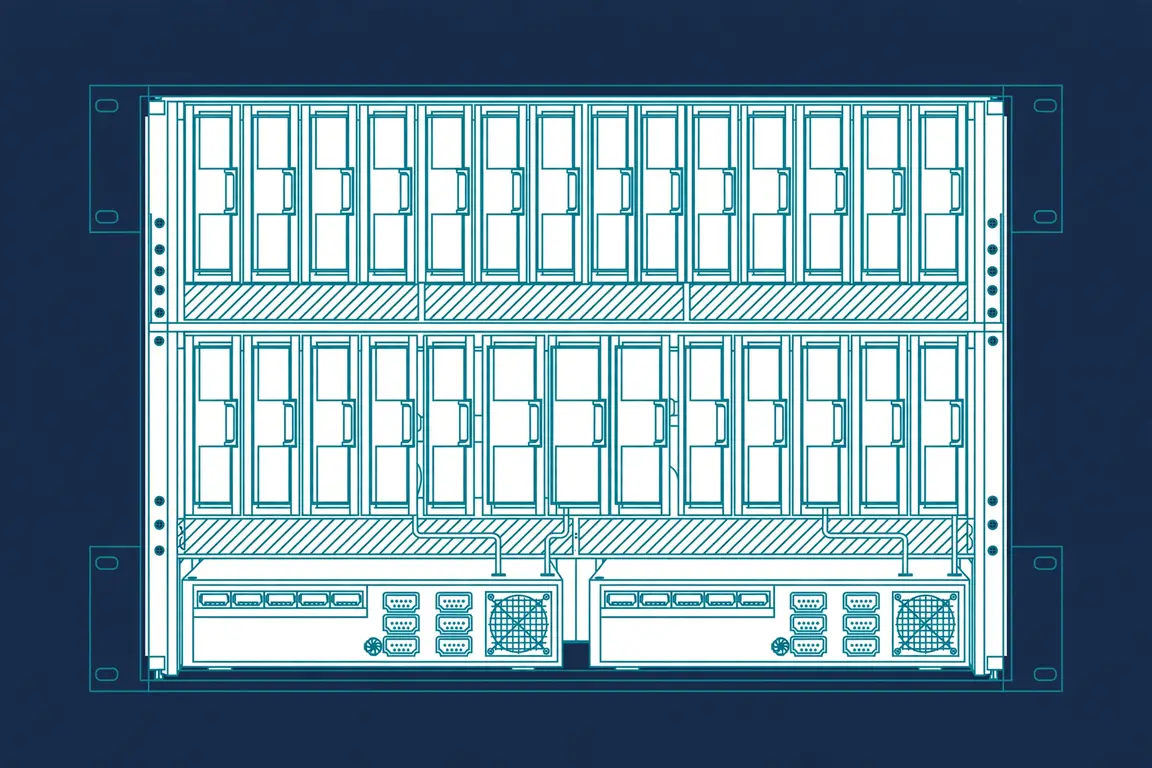
DAS: the array that belongs to its hosts
Direct-attached storage is the oldest layout in computing: the storage sits on a cable from the machine it serves. A DAS array extends a host's drive capacity beyond its chassis — more bays, bigger pools, hardware protection for the data — while remaining, logically, part of that host or a small defined group of them. Its virtues are the virtues of simplicity: nothing between the host and its data, no fabric to design or run, and a price per terabyte that shared systems struggle to match.
Its limits are the same simplicity viewed from the other side. Capacity bought for one host cannot serve another; an array attached to two hosts serves those two; and when a host fails, its directly attached data waits for the host. For fixed pairings — a database server and its expansion, a backup target behind one backup server — those limits never bind. DAS is not the unsophisticated option; it is the option whose trade-offs suit a defined, stable shape.
SAN: storage as a network service
A storage area network puts the arrays on a dedicated fabric and lets every host on that fabric reach every pool. Storage becomes a shared utility: capacity is bought centrally, allocated where workloads need it, and grown by adding arrays without touching hosts. A host failure stops being a data event — another host mounts the same volumes and the service continues. Virtualised estates live on SANs for exactly this reason: guests migrate between hosts because their storage never belonged to any of them.
The price is the fabric itself and the competence to run it: switches, host adapters, zoning, multipathing, and the discipline to keep a second network healthy for the life of the estate. Below a handful of hosts the overhead usually outweighs the sharing; above it, the alternative — capacity stranded behind individual hosts, unusable where it is needed — quietly costs more than the fabric would have.
Hybrid flash: the media decision inside the array
Hybrid flash is not a layout at all — it is a media strategy that either layout can use. A hybrid array holds both flash and spinning disk, keeps the active working set on flash, and lets cold data settle onto disk capacity, moving blocks between the tiers as access patterns change. The buyer-visible result is most of the estate's reads running at flash latency while most of its bytes sit at disk prices.
The alternatives frame its niche. All-flash buys uniform latency at the highest cost per terabyte and suits workloads whose working set is the whole dataset — dense virtualisation, hot databases. All-disk buys capacity at the lowest cost and suits archive and backup shapes. Hybrid is the considered middle: estates whose hot fraction is real but bounded. Sizing it means estimating that fraction honestly, because the flash tier must hold it or the design quietly becomes an all-disk array with expensive shelves.
How the three decisions interact
Layout first, media second. The layout question — who must reach this data, and what happens when a host dies — is architectural and hard to reverse; the media question is a sizing exercise inside whichever layout you chose. An estate can run DAS with hybrid media behind a fixed host group, or a SAN of all-flash arrays for a latency-critical cluster, and both are coherent designs. Confusion starts when the terms are treated as rivals on one axis: they are two axes, and the purchase has to fix a point on each.
Growth behaviour differs by axis too. SAN layouts grow by accretion — arrays and hosts added independently. DAS grows by replacement and attachment, in step with its hosts. Media grows by tier: flash shelves added to a hybrid array change its speed without changing its layout. A storage purchase made with ten years in mind states the growth expectation on both axes, in the inquiry, before any model is named.
A buyer's decision sequence
Four questions settle most real purchases. How many hosts must reach the same data — one or two points to DAS, many points to SAN. Must the data survive a host failure without waiting for that host — that is a SAN answer almost by definition. What fraction of the data is hot — that sizes the flash tier, or argues for all-flash if the honest answer is 'nearly all of it'. And how does capacity grow — locked to host purchases, or on its own schedule, which argues for the shared layout.
Our own storage range covers the points these questions land on: dense systems published for both SAN and DAS use, hybrid flash arrays for shared estates, storage servers for the integrated shape, and the drive lines that populate all of them. The questions come first; the catalogue is organised so that whichever answers you arrive with, the corresponding page is the next step.
Where the vocabulary goes next
Two neighbouring terms complete the buyer's map. NAS serves files rather than blocks — the right shape for shared documents and home directories, the wrong shape for database volumes. And hyperconverged layouts dissolve the array into the hosts entirely, replicating storage across the compute fleet: a legitimate third architecture whose scaling unit is the whole node rather than the shelf. Neither changes the decision method of this article — hosts, failure behaviour, hot fraction, growth — because the method is about your estate, not about the industry's vocabulary.
Vocabulary will keep moving; vendors rename the same physics every few years and charge the difference to marketing. Buyers who hold the four questions steady find that every new term resolves, on inspection, into a familiar point on the two axes: who can reach the data, and what the data sits on.
Questions buyers ask
Can DAS ever serve more than one host?
Small shared DAS arrangements exist for pairs and failover couples. Past a small defined group, the layout you actually want is a SAN, and buying DAS for it stores up a migration.
Is hybrid flash just a compromise?
It is a tiering strategy with a decade of production history. Where the hot fraction is bounded and known, it is usually the economically correct design rather than a compromise at all.
Price a configuration like this
Send the model name, your target configuration and the delivery destination. We reply with a configuration-matched quote and the checks to run before shipment.